
“When people are successful, it usually brings in hubris, overexpansion, a belief that we can’t miss, which is very dangerous.” – Howard Marks, Oaktree Capital
The mindset for building wealth is a close cousin to the mindset that destroys wealth.
For some retirees, the habits that made them wealthy are the very ones that could put their retirement at risk.
Meet Larry.
For most of his career, Larry won by taking risks. He borrowed when others saved. He invested when others hesitated. He leaned into uncertainty, used leverage intelligently, and trusted his ability to recover from setbacks. Larry’s mindset helped build his wealth — and it worked.
Now Larry is 67 and recently retired, and the hardest adjustment isn’t financial. It’s psychological.
Larry still thinks like a wealth builder. He sees cash and conservative investments (bonds) as wasted opportunities. When markets are trending higher, his instinct isn’t to prudently grow his portfolio, but to maximize returns with risk management as an afterthought. This mindset has always paid off for Larry and he’s not about to stop now.
But retirement calls for a different game to be played. To win the game, we must play the right game.
Larry no longer has decades of income ahead of him to absorb mistakes. Portfolio losses don’t just hurt; they could impair his capital base and increase the likelihood he runs out of money.
A nasty drawdown early in retirement doesn’t simply recover over time; it compounds against withdrawals, inflation, and the reality that Larry’s assets need to last the longest period of time the day he retires.
We call it sequence of return risk. In our opinion, it’s the biggest risk for new retirees.
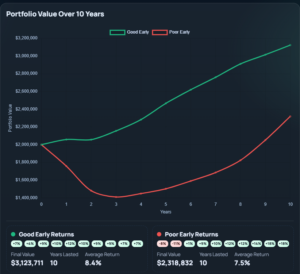
Let’s run Larry’s $2,000,000 retirement portfolio through two 10-year return sequences; one with good early returns (green) and one with poor early returns (red)…
Source: Chat GPT, Pure Portfolios
The above graph shows Larry’s $2,000,000 portfolio at the beginning of retirement. He withdraws 4% per year or $80,000 to supplement his lifestyle. The red line highlights poor returns at the onset of Larry’s retirement journey. Notice how “impaired” Larry’s portfolio becomes vs. the good early returns sequence. The difference of $805,000 represents a fine line between retirement success and retirement stress.
The scary thing about sequence of return risk is the early negative returns do not have to be catastrophic to impair a retirement portfolio. Back to the above graph, -8% & -11%, aren’t egregious outliers on the downside. Notice how the 10- year annualized returns are quite close as well, 8.4% (good early) vs. 7.5% (bad early).
The margin for a successful retirement journey vs. running out of money is closer than most think.
In Larry’s case, the same instincts that built his wealth now carry the risk of undoing it.
What can Larry do to downshift his mindset from wealth building to wealth keeping?
Find Your Enough – This is different for everyone and there’s no magic retirement number. I would classify an “enough” number that allows a person to do what they want, with who they want, when they want as a good place to start (see “There is No Magic Retirement Number”).
“It sounds rather simplistic; build wealth, find your happy place, and enjoy life. But there are countless examples of people building wealth, only to never take their foot off the gas. They keep pursuing wealth without ever considering the question, “what is my enough?
Prudence – avoid taking risks where the best outcome won’t change your life, but the worst outcome could drive your retirement plan into the ground.
Recognize the skillset for building wealth vs. keeping wealth are different. Turn off the relentless pursuit of more. Downshift. Retirees must play the right game (which might mean shunning good investment opportunities in favor of safety and soundness).
Dynamic Spending – did your portfolio have a great return year? Go ahead with that lavish kitchen remodel. Did your portfolio lose 20% of its value? Hunker down and tighten the purse strings.
Keep a Percentage of Retirement Portfolio in Safe/Liquid Assets – again, there’s no magic number here, but it’s usually best to meet expenses with cash vs. selling stocks during a market decline.
Stay True to Your Long-Term Investment Plan – we see so many “wealth building” portfolios for new retirees. These folks haven’t downshifted and are likely playing the wrong game, which probably doesn’t end well. Furthermore, most folks have no clue how much risk they are taking; until it’s too late.
From our post “Five of the Biggest Mistakes Investors Make,”…
“No one thinks about risk management during good times. This isn’t limited to retail investors. I can’t tell you how many times I’ve asked a prospective client working with another advisor to have them provide risk metrics. They come back with a variation of the same thing again & again, “my advisor doesn’t have access to that information.”
Don’t be like Larry. The skillset for building wealth and keeping wealth are entirely different. New retirees that can make the downshift have a higher probability of a successful retirement journey.
To learn more about how Pure Portfolios mitigates sequence of return risk for new retirees, shoot us a note insight@pureportfolios.com or click here.